
The best tennis rackets for sensitive arms (2026) — play without pain and avoid tennis elbow
If your elbow, wrist or shoulder complains after two sets, the racket is only half the story — strings and tension often matter more. Arm-friendly racquets buy you comfort, but only the right stringing keeps it. Choose wrong and a sore arm drags on for weeks. Choose well and it can disappear.
Updated:
Which racket should I use if I have tennis elbow?
If you have elbow symptoms (epicondylitis), you need to reduce the impact reaching your forearm on every shot. That depends on three factors: frame stiffness, stability at impact and the strings you use.
- The wrong racket can make the problem worse.
- The right racket can let you play without pain.
Key specs, side by side
| Racket | Head (sq in) | Weight | Pattern | Stiffness | Approx. price | Recommended level |
|---|---|---|---|---|---|---|
WilsonClash 100 v3 | 100 | 295g | 16x19 | 55 RA | €250 | Any level |
YonexAstrel 105 | 105 | 260g | 16x19 | 58 RA | €200 | Beginner / intermediate |
PrincePhantom 100X 18x20 (2024) | 100 | 320g | 18x20 | 59 RA | €200 | Advanced |
YonexEzone 100 (2025) | 100 | 300g | 16x19 | 64 RA | €250 | Intermediate |
VölklV-Cell 7 105 | 105 | 285g | 16x19 | 60 RA | €140 | Beginner |
Unstrung weight, string pattern and stiffness (RA) from each manufacturer's official specs. Prices are approximate European MSRP in euros.
How we picked — the criteria that actually protect your arm
No single factor defines comfort: the real behaviour depends on how the frame, the strings and your swing speed interact together.
- 01
Stiffness (RA) under 65
Frame stiffness is the main path for vibration to reach your forearm. Above 68 RA, even a perfect swing sends a sharp pulse to the elbow. Our five picks sit between 55 and 64 RA. RA alone isn't a pass, though — it interacts with strings, tension and swing speed. A 55 RA frame with stiff polyester at high tension can still hurt.
- 02
Weight between 260 and 320 g
Counter-intuitively, very light frames (<260 g) actually hurt more: they deflect on heavy incoming balls and the shock reaches the forearm. 285–320 g with moderate swingweight absorbs impact before it becomes vibration. If you generate little power, stay around 285 g; with a full swing, 305–320 g protects you better.
- 03
Even-to-headlight balance
Head-heavy balance (>335 mm) amplifies the shock wave on mishits. We prioritise balances between 315 and 335 mm — enough manoeuvrability without punishing the elbow when the ball hits outside the sweet spot.
- 04
Head 98–105 sq in for forgiveness
A larger head enlarges the sweet spot and reduces off-centre impacts — the main hidden cause of elbow overload. Below 98 sq in, forgiveness drops fast; above 106 sq in the frame becomes unstable on pace. 100–105 sq in is the arm-friendly sweet spot.
- 05
String pattern + frame stiffness (together, not separately)
A 16x19 or 18x20 on a flexible frame increases ball dwell time, and that's where real comfort comes from. The pattern doesn't hurt on its own — but a very dense pattern (18x20) on a stiff frame is an elbow trap. That's why we include only one 18x20 (the Phantom, at 59 RA) and leave out every stiff 18x20 on the market.
Find out which of these 5 fits you best in 60 seconds
The quiz factors in your level, playing style and swing speed — it doesn't give you the trendy racket, it gives you the one that fits your case.
Five rackets that genuinely protect your arm
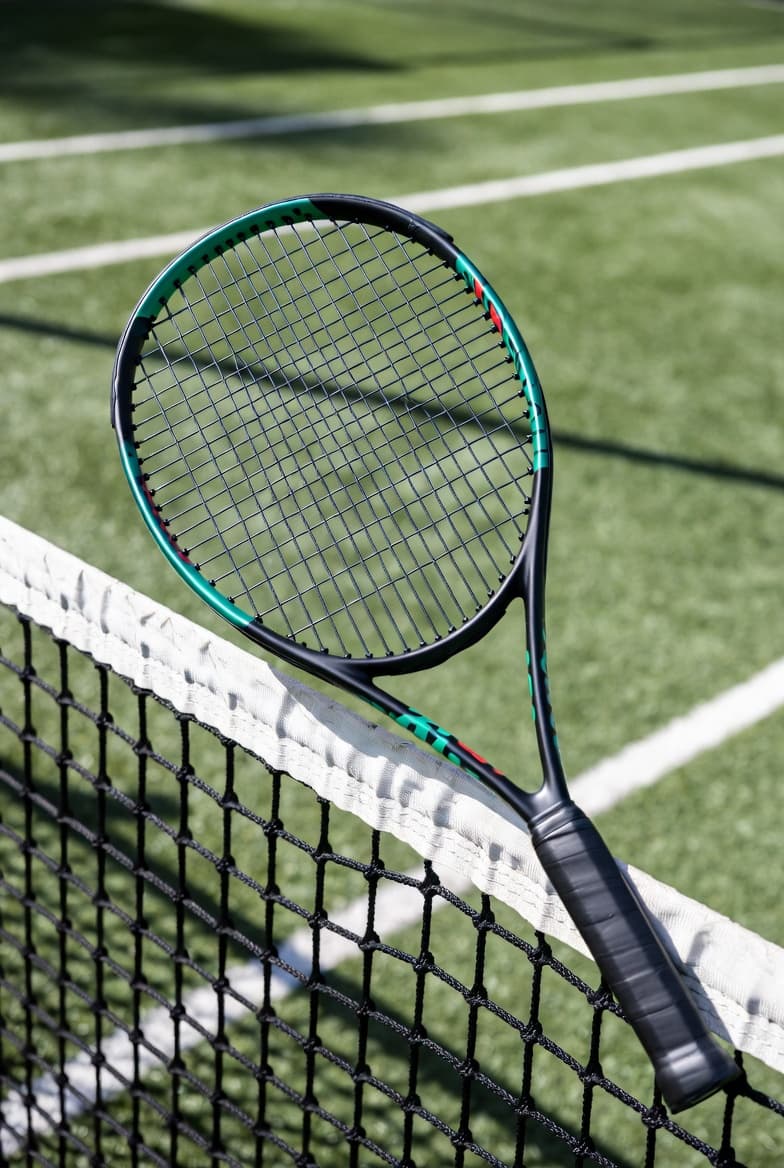
Wilson
The 55 RA reference
Safe pick€250
The Clash 100 v3 is the lowest-stiffness real performance racket on the market (55 RA) — yet it keeps the stability of a modern frame thanks to the SI3D + FortyFive° layup. It's the only option in this segment that lets you keep playing competitively without stepping down to a recreational frame. The v3 updates Wilson's Hit Stabilizer for cleaner off-centre impact — exactly where sensitive elbows get hurt most. 295 g unstrung, 100 sq in, 16x19. It's the safest pick if you're torn between several — hard to go wrong with it when your arm is symptomatic.
Best if
You have active elbow symptoms or a history of tennis elbow, and you refuse to give up competitive play.
Might not be for
You're used to a firm, classical Pro Staff feel — the Clash has a noticeably softer response some players describe as 'muted'.
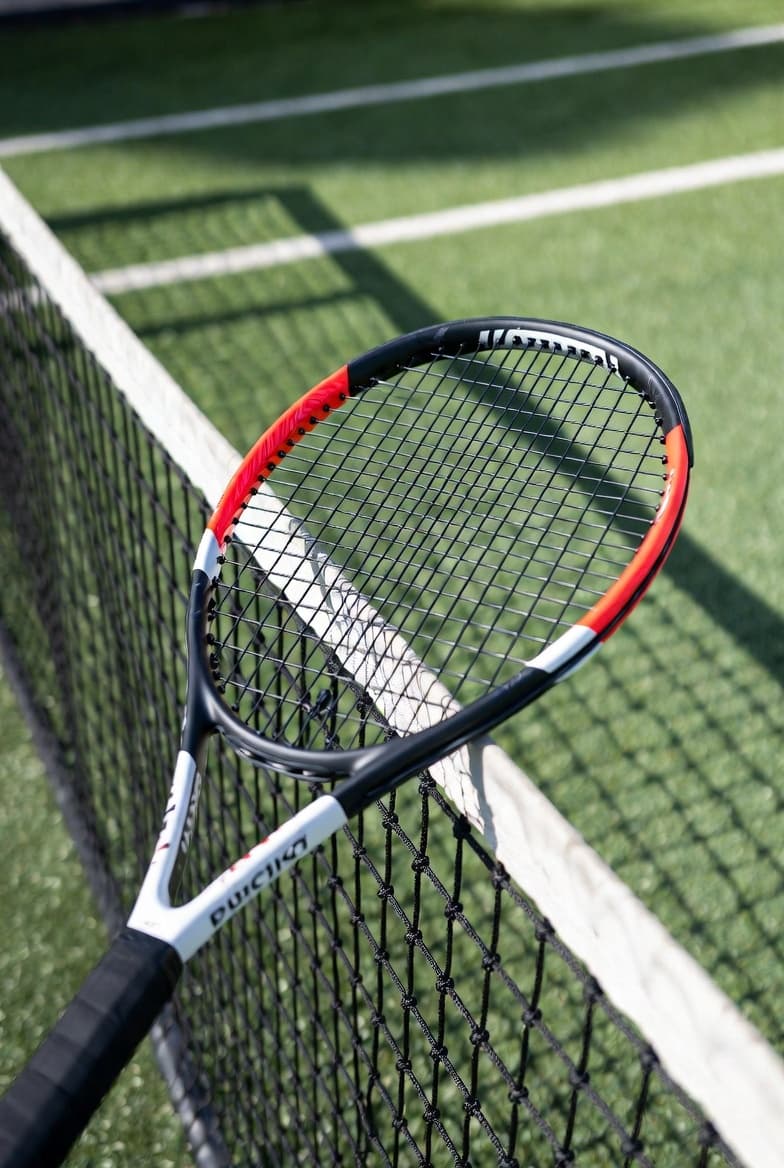
Yonex
Maximum joint protection
Safe pick€200
Built explicitly around comfort: Namd graphite flexes on contact, stiffness at 58 RA (second-lowest in the catalogue), 260 g and 105 sq in. The combination makes it the most forgiving option in this guide — ideal for players with symptomatic arms or who play several times a week at recreational pace. European MSRP around €200. Real trade-off: it's explicitly not competitive-grade.
Best if
You play at a recreational pace or have recurring discomfort and want maximum joint protection.
Might not be for
You play competitively or hit with real pace — at 260 g the frame gets pushed around by fast incoming balls.
Prince
The only arm-friendly 18x20
Safe pick€200
Dense 18x20 patterns traditionally mean stiff frames and harsh feedback — your elbow's worst enemy. The Phantom 100X 18x20 breaks the rule: 320 g, 100 sq in, 18x20 and 59 RA thanks to Zylon in the Anti-Torque System. You keep the directional predictability and the control of a dense pattern without the stiffness penalty. No real competitor exists at this exact spec.
Best if
You're an advanced player who values dense-pattern control but your elbow can't handle the stiffness of a Pro Staff or Pure Strike any more.
Might not be for
Your technique still produces frequent off-centre hits — the Phantom 18x20 is precise but unforgiving, and 320 g demands real swing speed.
Yonex
Power + comfort, not comfort instead of power
Safe pick€250
The 2025 refresh adds Minolon silk fibres to the shaft specifically to filter the vibrations that reach the forearm. 300 g, 100 sq in, 64 RA — slightly stiffer than the Clash or Astrel, but still at the upper end of the arm-friendly range and meaningfully more powerful. The thicker upper-hoop beam stabilises off-centre hits. This is the pick if you need comfort but refuse to give up the ability to finish points.
Best if
Your arm gets tired rather than sharply painful, and you want depth and power the Astrel can't deliver.
Might not be for
Your elbow is in active flare-up — 64 RA is the upper limit of arm-friendly; under a flare-up, stay at 58–60 RA.
Völkl
Entry-level arm-first racket
Safe pick€140
Völkl is the under-the-radar reference for arm-friendly construction, and the V-Cell 7 105 is the clearest expression of that at entry-level price (~€140). 285 g, 105 sq in, 60 RA. The oversize head and soft layup make it unusually forgiving for the price — a sensible frame when you've just had your first elbow warning and don't want to gamble €250 on a Clash yet. It's probably the most affordable way to test whether an arm-friendly frame actually solves your problem before investing more.
Best if
You're starting to feel discomfort and want a low-risk way to test whether a proper arm-friendly frame solves the problem before spending more.
Might not be for
You're already solidly intermediate — the V-Cell 7 105 will feel under-specced within a season.
Which pick actually serves which player
| Racket | Player profile | Best-matched style | OK with arm issues | Quick verdict |
|---|---|---|---|---|
| Wilson Clash 100 v3 | Any level with symptoms | All-court, competitive | Yes (RA 55 — reference) | Lowest RA in real performance frames. |
| Yonex Astrel 105 | 45+ or recreational with pain | Defensive, baseline | Yes (RA 58) | The most joint-protective pick. |
| Prince Phantom 100X 18x20 | Advanced with sensitive elbow | All-court precision | Yes (RA 59) | 18x20 control without the stiffness tax. |
| Yonex Ezone 100 (2025) | Intermediate with mild discomfort | Baseline / all-court | Yes (RA 64 + Minolon) | Most power inside the comfort zone. |
| Völkl V-Cell 7 105 | Beginner / improver with early symptoms | Easy, forgiving | Yes (RA 60) | Budget safety net before committing. |
Which one should you choose — by your actual case
You have active elbow pain right now
Drop to 55–58 RA immediately. The Clash keeps you competitive; the Astrel maximises joint protection. Whichever you pick, restring with multifilament at 23 kg before your next session — the racket alone won't fix it.
You compete and can't step down
The Clash protects without losing pace; the Phantom protects without losing precision. Both cost you ~5% in free power vs a stiff frame — far cheaper than six weeks off with elbow pain.
You play recreationally, 1–2 times a week
No need to spend €250+ when €140–200 already gets you 60 RA and an oversize head. Put the difference into two annual restringing passes with multifilament — bigger impact than the €100 racket upgrade.
You're coming from a Pure Drive, Pro Staff or Pure Strike
A 68–72 RA frame + polyester is the classic tennis-elbow recipe. Step 4–8 RA points down and switch to multifilament before you try any other fix — ~80% of cases resolve here.
If you're torn between two picks, the quiz helps you decide based on your level and playing style in under a minute.
Clash vs Ezone vs Phantom: which is best for your arm?
All three are arm-friendly, but they tackle different problems. Compare them on comfort, power, control and technical demand to pick the one that fits your case.
Clash 100 v3
- Maximum comfort (RA 55)
- Soft, forgiving feel
- Best pick if you have active pain
Ezone 100 (2025)
- More useful power (RA 64 + Minolon)
- Less physically demanding than the Phantom
- Best if symptoms are mild or intermittent
Phantom 100X 18x20
- Maximum control and precision (18x20)
- Technically demanding — forgives little
- Best if you're advanced with a sensitive elbow
Quick take → Strong pain: Clash · Power/comfort balance: Ezone · Advanced control without the cost: Phantom.
Common mistakes that make elbow pain worse
Here's the most common mistake: changing rackets without changing strings. Four failures below drive most tennis-elbow cases — none of them depend on the racket alone.
Using harsh polyester when your arm already warned you
A 55 RA racket strung with stiff polyester at 26 kg transmits more shock to the elbow than a 68 RA frame with multifilament at 23 kg. If you have arm issues, change strings before you change racket — otherwise you'll blame the wrong thing and spend €250 to fix a €20 problem. Rule of thumb: multifilament or natural gut first; poly hybrid only if your elbow is currently asymptomatic.
High tensions (above 25 kg)
Above 25 kg any frame feels harsher and ball dwell time drops. Below 22 kg you lose control. For sensitive arms: multifilament at 22–24 kg, or poly/multi hybrid (poly mains at 22 kg, multi crosses at 23 kg). Cranking tension to gain control almost always costs more than it returns once your elbow is symptomatic.
Confusing light with comfortable
A 260 g frame deflects under heavy incoming balls, and that deflection reaches the forearm as vibration. Sensitive arms usually do better with 290–310 g and moderate swingweight — the mass absorbs impact before it becomes shock. Don't drop below 275 g unless you specifically need oversize forgiveness (Astrel 105, V-Cell 7 105).
Not restringing in time
Strings lose tension and elasticity before they break — and when they do, they start transmitting vibration to the arm even if they still look fine. Rule of thumb: restring as many times a year as you play times per week. If you play twice a week, restring at least twice a year. Many elbow cases don't come from picking the wrong string, but from not changing it when it was due.
Frequently asked
- What racket should I use if I already have tennis elbow (epicondylitis)?
- First: stop playing until the acute phase resolves — no racket in the world fixes active inflammation. When you restart, a 55–60 RA frame (Clash 100 v3, Astrel 105, Phantom 100X 18x20) paired with multifilament at 22–24 kg is the right starting point. If symptoms persist after 2–3 months with the correct setup, see a sports physio — the issue may no longer be the racket.
- Can I keep playing with elbow pain if I change my racket?
- Possibly — but it's the wrong question. Playing through pain pushes tendinitis toward chronic injury that sidelines you for months. The honest answer: reduce intensity first, change strings, then test whether a softer frame lets you play without discomfort. If yes, progressively return to full play. If no, rest is the only real path.
- What string tension is best for arm-friendly play?
- 22–24 kg (48–53 lbs) with multifilament is the standard recommendation. Pure polyester only at 22 kg and only for short periods (30–40 hours of play), because poly loses responsiveness fast and then becomes a shock transmitter. Natural gut at 24 kg is the gold standard for comfort — but expensive and fragile in humid climates.
- Multifilament or polyester — which and when?
- Multifilament (Wilson NXT, Head Velocity, Tecnifibre X-One Biphase) for any player with arm issues, any level. Polyester (Luxilon Alu Power, RPM Blast) is for advanced players with healthy arms and heavy swing speed — it gives spin and control at the cost of comfort. Hybrid (poly mains, multi crosses) is the middle ground for competitive players with mild symptoms.
- Is a more expensive racket more comfortable?
- No. The Clash 100 v3 at €250 and the V-Cell 7 105 at €140 both measure as arm-friendly. What correlates with comfort is stiffness (RA) and construction, not price. A €300 Pure Strike 18x20 (70 RA) is worse for the arm than a €140 V-Cell 7 105 (60 RA). Price correlates with performance and materials — not with joint protection.
- Clash 100 v3, Ezone 100 or Phantom 100X 18x20 — which should I pick?
- Clash if your absolute priority is dropping stiffness to 55 RA while staying competitive — the safest choice. Ezone 100 if your arm is only mildly sensitive and you want more power (64 RA + Minolon). Phantom 100X 18x20 only if you're advanced, you want a dense pattern, and your technique doesn't produce frequent off-centre hits — it forgives little despite being arm-friendly.
- Which racket works best if I'm coming from a Babolat Pure Drive?
- The Yonex Ezone 100 or the Wilson Clash 100 v3 are the most natural transitions from a Pure Drive: they keep the power you liked but drop stiffness (from ~72 RA to 55–64 RA). If you also switch from polyester to multifilament at 22–24 kg, you cover both sides of the problem without giving up aggressive play.
Your elbow deserves better than trial and error.
In under 60 seconds, the engine analyses your profile and recommends the 3 best options with arm-friendliness already pre-weighted.
How we evaluated each racket
This guide is not a list of generic opinions. Every pick comes from the same deterministic engine powering the quiz, and its specs are verified against official sources.
- Specs: head, weight and string pattern straight from the manufacturer's official pages.
- Stiffness (RA): Tennis Warehouse University RDC lab measurements where available.
- Prices: official European MSRP in euros — not volatile promotional prices.